新津温泉
- monday
- 9 AM–6:30 PM
- tuesday
- 9 AM–6:30 PM Hours might differ
- wednesday
- Closed
- thursday
- 9 AM–6:30 PM
- friday
- 9 AM–6:30 PM
- saturday
- 9 AM–6:30 PM
- sunday
- 9 AM–6:30 PM
- Phone
- +81 250-22-0842
Niitsu Onsen is famous for its strong smell of petroleum. The reason for this is that Niigata Prefecture is one of the few prefectures where oil is still extracted. And until the end of the Taisho period, Niitsu was a treasure trove of oil fields, boasting the highest oil production in Japan. Niitsu Onsen was discovered as part of the oil field development. Perhaps because it's near an oil field, although it's called a hot spring, it has a strong smell of petroleum. Also, if you look closely at the bathtub, you can see that it's a slightly brownish color. I had heard that it was a petroleum hot spring, so I thought it might be covered in tar, but that wasn't the case. However, if you look closely at the bathtub, you can see a brownish substance floating in it, and a film of oil on the surface. Hot springs with oil mixed in are extremely rare, even across Japan. After bathing, your whole body will smell of petroleum. Furthermore, the white towel I washed in the hot spring water was slightly stained brown. That's nerdy. This is a very nerdy hot spring. The fee was ¥500. Of course, payment was cash only. I was rudely refused, saying they couldn't provide a receipt. While requesting a receipt is a legitimate customer right under the Civil Code (Article 486, Paragraph 1), I didn't want to get into an argument with the storekeeper, so I just backed off. It may just have been bad timing, so if you need one, don't be discouraged and ask. (In the first place, few people need a receipt for hot spring bathing, so in reality, it shouldn't be a problem.) How to get to Niitsu Onsen from Tokyo Drive from Tokyo to Niitsu Onsen. Take the Shinkansen to Niigata Station, then ride your road bike from there. (This is the easiest route.) Head north to Koriyama, pass through Aizu and Aga Town, and then cross the Japanese archipelago to Niitsu. And what's more, you might even end up heading straight into the Sea of Japan. (This is an interesting route for touring.) Good luck! That concludes Manager Racco's bicycle journey.
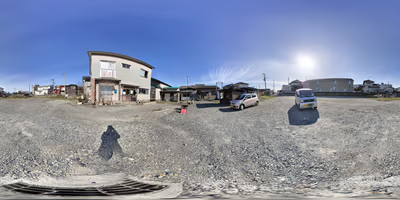
Highly recommended for those who want to experience a rare, unusual, or niche hot spring. 【Smell】 A scent of petroleum or gasoline. It's not overwhelmingly strong or noticeable to others, but there's a faint fragrance. The towels soaked in the water retain the scent for a long time, and you can smell the hot spring scent on your body for about a day. 【Hot Spring】 After bathing, your skin feels incredibly moisturized, smooth and supple for a long time. Contrary to the smell, it's a wonderfully comfortable hot spring that truly embodies the feeling of a soft, supple skin. The water temperature is very pleasant, making it a lovely hot spring where you'll want to soak for a long time, forgetting the passage of time. You can enjoy the unheated spring water only from July to September. 【Facilities】 Towel rentals or sales, shampoo, and body soap are not provided. You must bring everything yourself. There are three washing areas. Wash buckets and bath chairs are available. 【Recommended Bathing Time】 It's less crowded around lunchtime. It seems to get crowded with locals in the mornings and evenings. [Fees] Adults: 500 yen. Children: 300 yen. Payment is cash only. [Access] ■By Car The route from Prefectural Road 7 (Niitsu-Muramatsu) is the easiest way to access the parking lot. A landmark is a small sign for "Iino Construction Niitsu Onsen" along the prefectural road when driving from Niitsu Station. It's easy to miss, so it's recommended to check your navigation system beforehand. ■By Train About a 15-minute walk from the east exit of JR Niitsu Station. Going via the shopping street is recommended. You can rent bicycles for 100 yen a day at the tourist information center "Ah! Kiha Tourist Information Center" on the first floor of the station, so you can combine a visit to the railway museum with a bicycle ride. It takes less than 10 minutes by bicycle from the station to Niitsu Onsen, and about 12-13 minutes by bicycle from Niitsu Onsen to the railway museum.
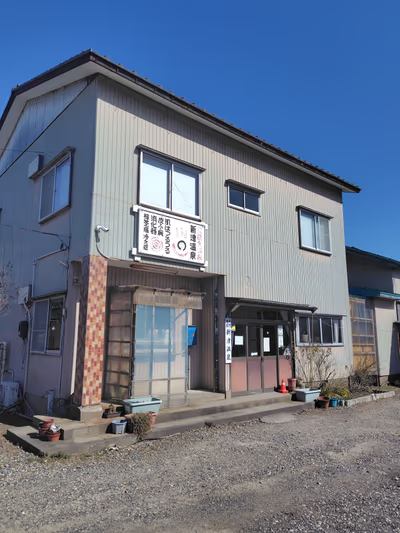
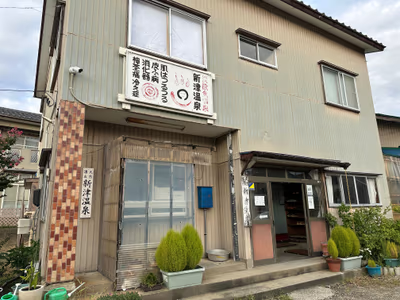
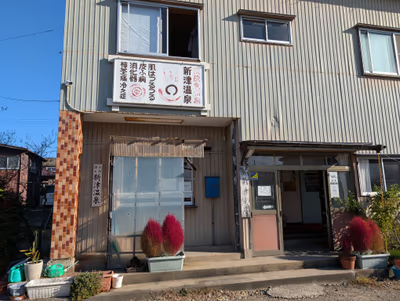
From the outside, it looks like a construction site. However, in reality, it's a local hot spring beloved by locals and traveling motorcyclists. Adult admission: 500 yen The bathroom is old. To put it nicely, it's retro. The tub was small enough to fit five adults, so with six people in total—two elderly people and four of us—it was completely over capacity. However, two regulars told us not to be shy, so we soaked in a Tetris-like, complex formation. The water was lukewarm, but thanks to the sodium chloride bicarbonate spring, I felt warm for a long time after bathing. What's more, the oil-rich water left my skin feeling moisturized and smooth. This area has long been an oil-producing region, with the remains of an oil well known as Sekiyu no Sato Park. Niitsu Onsen apparently began as a hot spring during oil mining. It was my first time experiencing a water bath containing oil, so at first I was bothered by the oily smell, reminiscent of an auto repair shop. However, you soon get used to it, and once you get used to it, it's simply a warm, comfortable bath. I ended up soaking for a long time. The two elderly people come here almost every day, and they say this is the best hot spring in Japan. In fact, when we arrived, they had already been soaking in the hot water for an hour, and were floating in the water like kelp.
I came here after reading in a book about a hot spring that smells strongly of oil! It's great! This is the first time I've ever been in a hot spring that smells like this! Although it was clearly stated that you cannot drink the water at this hot spring, I really wanted to try it, so I took a sip at my own risk. It was a very strange sensation. The water was salty. And then my mouth suddenly smelled strongly of petroleum, lol. What is this?! It didn't taste like oil, but my mouth was filled with the smell of oil. It was so strange that I took another sip. Again, it was salty first, and then a faint scent of petroleum. It doesn't seem very good for the body, but it was a valuable experience. The water was also slightly slippery and greenish in color. I also had a pleasant conversation with a local grandmother, and I was very satisfied with the wonderful hot spring. On the way home in the car, every time I ran my fingers through my hair, I smelled petroleum, and I thought, "This is great!"
This is a rare hot spring in Japan, where the smell of petroleum can be heard from the source. It seems to be good for the skin, and it cured my dry, flaky legs! It may be an exaggeration to say it cured me, but the itching subsided and the flaky skin lessened a little, which surprised me! After bathing, my whole body smells like kerosene, but it feels moist and nice. It looks like it will completely cure the flaky skin on my legs after a few baths! The source water is lukewarm, so you can soak for a long time. The temperature is high right after opening in the morning, and it gradually becomes lukewarm, so it may be best to go early. *Apparently, they will heat the water if you tell the staff, but it seems that many regulars choose not to heat it as it dilutes the water^^;
Showing the longest 5 of 10 visitor reviews. Reviews are displayed under fair use for editorial commentary; full text and authorship credit belong to the original reviewers.
Make a day of it — a quick-dry towel, dry bag, and post-soak layers take almost no pack space.
Shop outdoor gear at Traverseon →Affiliate link — SoakNation may earn a commission at no cost to you.How we make money